
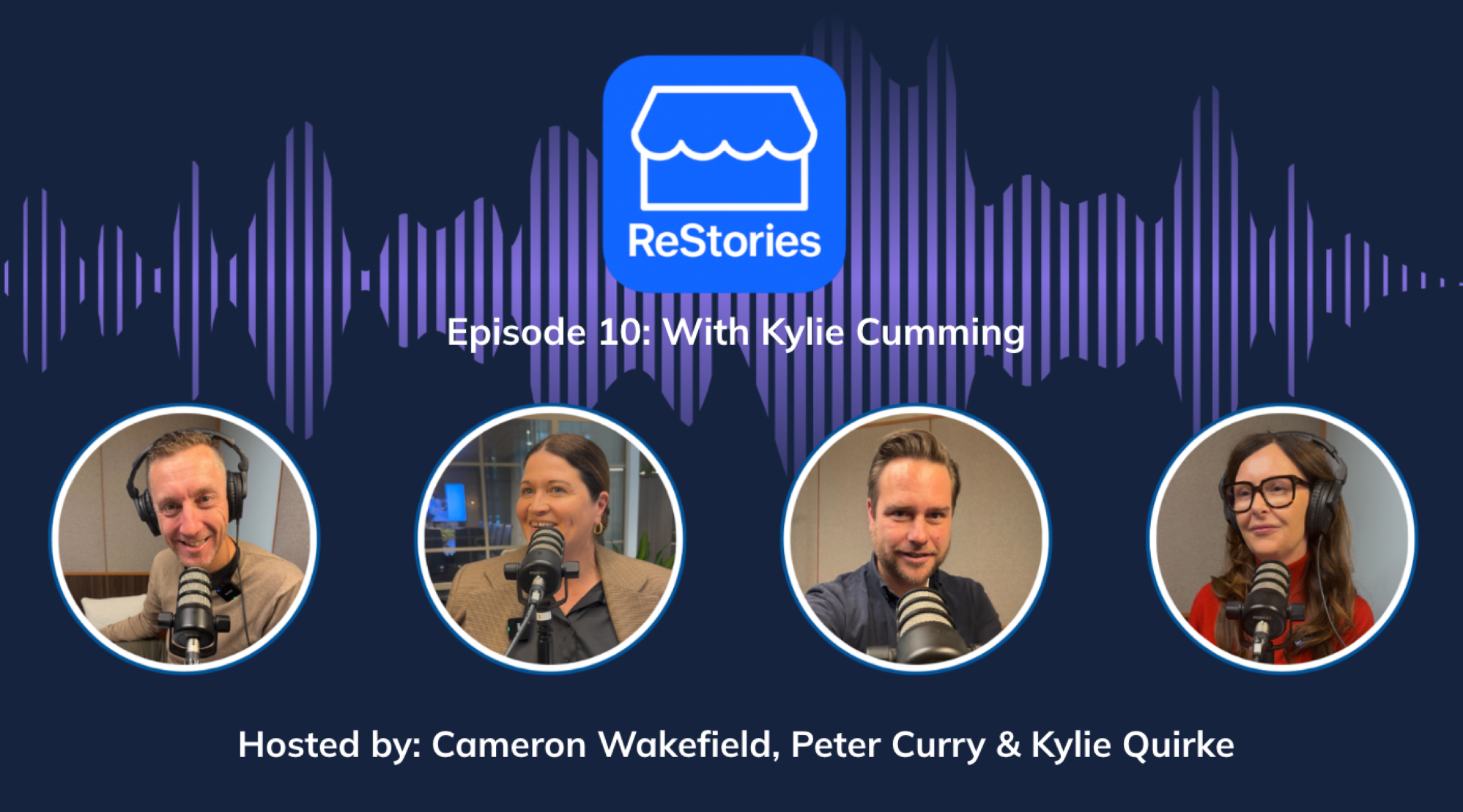
ReStories Podcast: Episode 10, with Kylie Cumming.
Intro (00:00)
Welcome to ReStories.
“And then it was like our online sales were… the phones were blowing up. We’d never had that many online orders, ever.”
“He wasn’t very happy to see me, so the first thing I thought was, I’d better get rid of the shotgun. Just in case.”
“You know, when you’d spewed up in the back of their car, or you wanted their parents to bail you out, I was always given that green light: ‘Well, Paul’s a good lad.’”
Intro (00:19)
“They knew you.”
“I didn’t know how to use Google Sheets, and I didn’t know that everyone could see them.”
Peter Curry (00:28)
Recorded at the Restore for Retail studios in Melbourne, this is ReStories. Well, hello, and welcome to ReStories. My name is Peter Curry, and with me in the studio are Cameron Wakefield and one Kylie Quirk. How are we, guys?
Kylie Quirke (00:43)
Very good, thanks, Peter.
Peter Curry (00:44)
Great.
Cameron Wakefield
Great, Pete. Thanks for asking.
Peter Curry
Thanks so much. Now, a bit of a precursor to this episode: there are going to be two Kylies in the room with us, including our special guest, who we’ll introduce later. So, just as a disclaimer: two Kylies. Don’t get confused. We’ll make it easier for you; we might even abbreviate their names, but let’s talk about that later. First, I had another retail reflection this week, as we talk about every month. I went shopping yesterday, and I won’t tell you what I was buying. Well, I was buying weatherproof pants for golf, but that’s not interesting.
Cameron Wakefield
Late in the season, Peter.
Peter Curry
Very late in the season. It is, it is. We’re off to a very wintry, windy island off the coast of Tassie. Anyway, that’s not the story. The story is that I walked into the cubicle, the change room, and there was a sign saying, “Please return all clothing you’ve tried on to the front counter.” And you know what that had me doing? Reflecting on myself as a customer. Now, I’m not sure many people out there do this, but you’re the retail people, and I’d like to find out whether I’ve been committing some faux pas while shopping. So the first question is: is that normal? Do shops normally want people to return the clothes they’ve tried on to the counter?
Kylie Quirke (02:00)
Not in my world, Peter.
Cameron Wakefield (02:03)
More so recently. In the past, I think retailers would typically have had someone in the fitting room supporting you while you tried things on, but perhaps they’ve reduced their labour and are asking you to bring it all the way to the counter, where they’ve definitely got someone.
Peter Curry
Well, they were very helpful people, so I don’t think it was a lack of trying. But yes, potentially there was another reason behind it.
Kylie Quirke (02:24)
Definitely a case of not wanting to do it themselves. I’d read a sign like that and immediately be turned off, and think, “That’s not the customer service I want in a store.” They’re probably doing some great things to manage with one or two people on the shop floor and get their productivity up, but it’s asking the customer to do more, and the customer has an expectation. So how did you feel about it?
Peter Curry (02:49)
Well, it wasn’t easy, I’ll tell you that. I didn’t think too deeply about it. I did return all the clothing I’d tried on. But look, to be honest, they were actually quite helpful in the end. But that got me thinking about other things. When I go shopping, is it okay for me to bring a coffee into the store?
Cameron Wakefield
Depends on the store.
Kylie Quirke (03:10)
I think so. I think it is.
Cameron Wakefield (03:12)
It is. It’s all part of the experience. If you’re a mature adult, you should be able to get through the shopping experience without spilling it, I’d say.
Kylie Cumming (03:19)
That’s right.
Kylie Quirke (03:21)
And back to your original experience: not every customer would leave their things on the floor and walk out. I’ve been a retailer, so I’m someone who actually has empathy, and I hang things back and make their job easier.
Peter Curry (03:38)
When you say you hang things back, you’d grab the things you tried on in the change room and actually go back to the spot you took them from and hang them up?
Kylie Quirke (03:46)
Yep, pretty much, most of the time.
Peter Curry (03:48)
You’re the perfect customer, I think! And the last one, and I don’t know if this irks you or not, but thinking of little faux pas when you shop: is it okay to walk into a shop while you’re on your phone?
Kylie Quirke (03:59)
I think being on your phone is fine, but I’ve learned something as a customer. If I’m in the car on the phone, I’m still on the phone when I get to the local shop, or when I’ve got to grab a bottle of wine. And on many occasions I’ve had a very dirty look from the person serving me because I’m on my phone, and I’ve reflected and gone, “That’s actually quite rude.”
Cameron Wakefield (04:23)
And I think the other thing is that, as someone working in the industry, you want to understand the experience you’re getting in the store. You need all your senses focused on what you’re doing in that store to get the full picture of the experience you’re receiving at that point. So you probably shouldn’t be on your phone.
Peter Curry
Well, I’m now more aware, and as I walk in I’ll be watching both whether I’m doing my job and whether the person behind the counter is doing theirs. So thanks for your retail insights. Speaking of retail insights, Cameron, who’s our guest today?
Cameron Wakefield
Thanks, Peter. Today our guest has spent 25 years in fashion and retail: from Ralph Lauren in Australia and New Zealand, then across the world in the UK and Europe, through to general manager at Bonds and at Camilla and Marc, CEO at Little Joe Woman, interim CEO at MISHA, and, most recently, four and a half years at Hello Molly. She now runs Kylie Cumming Advisory, working as a fractional CEO and adviser to boards and founders. Kylie Cumming, welcome to ReStories.
Kylie Cumming (05:18)
Thank you, Cam. Lovely to be here.
Cameron Wakefield (05:20)
Awesome. And we’ve got Kylie Quirk as well. Welcome, Kylie.
Kylie Quirke (05:23)
Hi. I think we’re going to use “KQ”…
Cameron Wakefield (05:25)
Okay, perfect.
Kylie Quirke (05:26)
…today, because there are two Kylies. Even though my voice is probably a bit more Aussie, or a bit higher-pitched, I can be referred to as KQ today.
Cameron Wakefield (05:42)
Awesome. I’ll do my best. So, Kylie Cumming, for the listeners who don’t know you, can you start from the beginning? How did you get into the retail industry?
Kylie Cumming (05:52)
It all started way back, when my mum and my auntie owned a boutique in our regional town, Mildura. I went on my first buying trip with them when I was 10 or 12, just to Melbourne, of course, and I guess that’s where the interest started. I worked in boutiques while I was at high school, but I decided not to go into fashion; I went on to study town planning instead. I didn’t like it, so I thought, “Well, maybe I’ll try retail and open my own boutique.” At the time, obviously, things weren’t online, and for anybody living in a regional town to buy those cool brands, they had to travel to Melbourne or Sydney. So I decided to bring all the cool brands from Melbourne and Sydney to Mildura.
Kylie Quirke (06:50)
Hmm. Amazing.
Cameron Wakefield (06:51)
You can take the girl out of retail, but you can’t take retail out of the girl. So you go back to retail, and at some point Ralph Lauren comes calling. Can you tell us how that happened and where it started?
Kylie Cumming (07:05)
After a few years of having the store, I decided it was time to head to the big smoke, so I moved to Adelaide. I actually had two job offers: one at Esprit, and the other at East Coast, which you probably don’t remember or know, but it was a denim brand. I went with Esprit and stepped into running their flagship store in Rundle Mall and looking after their other stores in Adelaide. I was there for a couple of years, and then I had to go to Sydney for a senior managers’ conference. A girl who’d worked for me was working at Ralph Lauren at the time, and it was just as the Lane family had taken back the licence. They’d bought out the other two partners and were about to embark on opening a lot of stores. She said, “I’d love you to meet my boss. I think he’d love you. They’re looking for somebody like you. Would you be interested?” I said, “Sure.” So I went and had a coffee, and by the end of the day I basically had a job offer to start at Ralph Lauren.
Cameron Wakefield (08:20)
So did your paths cross at that point?
Kylie Quirke (08:22)
No, they didn’t. I worked for Oroton Group after Kylie had left. But Kylie and I have known each other for the past two years now, and we have ex-colleagues who’ve commented on our LinkedIn posts, or who know us both well, so we’re joining the dots. But we didn’t actually work together at Oroton Group.
Cameron Wakefield (08:48)
And Kylie, you didn’t stay in Australia with Ralph Lauren. You started to travel. Tell us what happened.
Kylie Cumming (08:56)
Yes. I spent five and a half years here in Australia, opening up all the retail stores, including the first Polo Sport store, with lots of travel and exciting store openings. But I wanted a change, and I wanted to move somewhere else to see what else I could get out of Ralph Lauren. So I decided to move to London.
I had three job offers: one in retail, one in their outlet business and one in their wholesale business. I took the wholesale one, which was a retail development role within wholesale. It was huge. It was massive. I was travelling constantly; I was hardly in London at all. Every week I was in another country, or two or three. I’d always make sure I ended up in Paris at the end of the week, so I could jump on the train and grab my little macarons and all the fun things to take back to London. It was a really exciting time. I remember flying into Vienna once and thinking, “I’m so tired. I’m so over this.” And then I caught myself: “I can’t believe I’m saying this while flying into Vienna!” But it’s work, and work is busy. There were lots of cultural differences to manage, with teams in Germany, Spain, France and, obviously, the UK. That had its own challenges, but it was a huge learning curve for me. I was fortunate enough to travel to New York really frequently, spending time in head office there and working closely with the store development and creative teams. Again, the UK and Europe licence had just been taken back, so it sat under Ralph Lauren itself rather than a licensee. So there were a lot of changes and a lot of interaction with the New York head office, which was brilliant. I certainly got a chance to work with some great people.
Cameron Wakefield (11:15)
There’s so much to unpack there. For the listeners, and for me, can you tell us a bit more about what that role involved? What is store development, and how does it work?
Kylie Cumming (11:25)
Within department stores, you have shop-in-shops. Some are concessions, but a lot of them are wholesale. Over in Europe and the UK, and the same in the US, they’re their own shops. They’re fitted out, we have staff, merchandisers and salespeople, and we manage our business within the department stores’ businesses.
It was very much about constantly renewing the shop fits. We spent a lot of time trying to get them right for the European customer, as well as trying to get the product right. We were the voice of Europe back to the New York head office. At the time, Ralph Lauren’s chinos were still really wide and their Oxford shirts were still really big, and we were saying, “No, Europe is all about slim legs and fitted shirts. It’s different.” We had to spend quite a bit of time working with New York to help them understand that. We certainly got there, and it did change the product and the shop fits. We were continually revamping them to suit each of the different regions. We did a couple of the bigger refits: the Selfridges refit was massive, and there were refits at Harrods and Harvey Nichols. They were big, big jobs, and there were lots of layers to work through with those department stores. And there were teams of salespeople and merchandisers in each of the countries I was responsible for.
Kylie Quirke (13:10)
And sorry, Cam: the brand integrity piece, upholding the existing brand but also really enhancing it for those markets, would have been a huge project in itself.
Kylie Cumming (13:26)
Yes, absolutely. When you’re in Europe, you’re competing against the European brands. This was obviously a well-known American brand, but Europe is different, and you’re competing against those local brands. It had a good footprint, and as we know, it’s not just menswear; it’s womenswear, kidswear and sport. It was all those categories. It was definitely successful.
Cameron Wakefield (13:54)
It’s amazing when you think about these iconic places in retailing: Harrods, Selfridges, Galeries Lafayette. Those awesome buildings are like the meccas of retail, and you were in there shaping how they looked, which is awesome.
Kylie Cumming (14:09)
Certainly. At the time, it doesn’t feel surreal, because you’re in it. But now, when I reflect (and it was quite some time ago), you think, “Wow, that was pretty amazing. That was a great experience.” And it certainly set me up to do what I did when I came back.
Cameron Wakefield (14:29)
So let’s talk about that. You were there for seven years. What were the key lessons and learnings? Was it a massive case of drinking from the fire hose, learning and growing almost every day?
Kylie Cumming (14:41)
Yes. Ralph Lauren was unbelievable in that space. If I sit and reflect on my best years in retail, it’s definitely my time at Ralph Lauren. It was different. It was a global brand…
Kylie Cumming (14:57)
…it’s luxury, and it just had everything right. Right down to store training, everything was absolutely spot on, and you lived and breathed it. That’s really what working at Ralph Lauren was. We talk about retail being theatre, and Ralph Lauren is. It’s that world of Ralph Lauren. It’s not just about the product; it’s about really embracing the lifestyle. That was a great teacher.
Cameron Wakefield (15:26)
As you came towards the end of your seven years, you obviously made a decision at some point. Do you remember making the decision to leave and move on to the next opportunity? Can you tell us about that?
Kylie Cumming (15:35)
That was homesickness.
Kylie Quirke (15:38)
Yeah.
Kylie Cumming (15:40)
To return…
Cameron Wakefield (15:40)
Yes, I think you’re entitled to a little bit of that.
Kylie Cumming (15:42)
…home. So I came home and spent the first few months up in Brisbane, to get some sunshine. A couple of my girlfriends had moved from Sydney to Brisbane while I was away, so I went and spent some time there and actually helped out, because they’d opened a few Ralph Lauren stores in Brisbane at the time. So I was keeping an eye on things and helping the GM out. Then I decided to come back to Sydney and launch my consulting business. That was interesting, because every time I started consulting to a brand, I’d then be asked to step in and manage the business, which worked out fine. It started with Camilla and Marc, when they were just babies. I started consulting to them many years before I stepped in as their GM, and that’s typically how it went with most of the roles I stepped into.
Cameron Wakefield (16:43)
Why is that? That’s definitely a trend on your CV. Tell us why.
Kylie Cumming (16:48)
Okay. I think it’s…
Kylie Quirke (16:50)
She’s too good.
Kylie Cumming (16:52)
I’m not going to say that! I think…
Cameron Wakefield (16:56)
But now that someone’s said it…
Kylie Cumming (16:57)
That was Kylie Q, by the way! I think it’s that when I start working with any brand, I’m all in. And particularly with founder-led brands, you take on a little bit extra. There’s an emotional connection to the business for them, and you genuinely want them to succeed. I guess that comes through in my approach: how I get to know the business and try to understand the areas where I can add value, and then really take the lead and push the business forward. I’ll typically develop a strategy, so it helps that I’m then in the business to take it through.
Cameron Wakefield (17:47)
And consulting is often criticised because you devise a strategy and then walk away.
Kylie Cumming
Yeah.
Cameron Wakefield
You’re bucking that trend.
Kylie Cumming (17:55)
I am. It’s not how I work, and it’s not what makes something successful, in my mind. You’ve got to live and breathe it. You’ve got to understand it. I work very closely with the teams, making sure they’re developed and executing their part of the strategy well. So I spend a lot of time mentoring, coaching and working alongside the teams, even when I’m not sitting in the business. It’s important. Consulting has a bit of a bad name, and I don’t particularly like using the word.
Kylie Quirke (18:26)
Okay.
Cameron Wakefield (18:28)
So you were home in Australia at that point, but you didn’t stay home for a tremendously long time. I think you went overseas again, into Asia this time. Can you tell us about that?
Kylie Cumming (18:37)
Yes. I continued to consult, and then we had my first child, in Sydney. I was still working with Little Joe at the time, and that was challenging. Obviously, when you’re a [inaudible], you’d just take him into the office, and he’d be well looked after. But over time, I decided it was time for a change, and I went and did some work with Sass & Bide, and then on to Camilla and Marc after that. While I was still at Camilla and Marc, we moved to Melbourne, and our second child was born. While they were still young, I remember pushing the pram down to the local café every morning, doing the same thing, two children in tow, still working, still consulting.
While I was doing that, and the second was still quite young, I actually launched Bonds Online. At the time, they’d lost one of their big accounts, Kmart, so the wholesale division was starting to shrink, and they needed an opportunity to make up the shortfall. So they decided to embark on a retail strategy. I came in and launched that Consumer Direct division: I launched Bonds Online, worked on the strategy for the retail stores, and worked very closely with the outlet stores. I did that for just over a year, and then my husband decided to take a job in Bangkok. Life had become very much the same, doing the same thing every day, so we thought, “While the kids are young, why not? Let’s throw them into a different culture, different everything.” I never thought I’d live in Bangkok. I’d travelled there, but living there as an expat was one of the best experiences I’ve ever had, and we made great friends with some local families, which was pretty amazing.
Cameron Wakefield (20:42)
How many years were you over there, and why did you decide to come back?
Kylie Cumming (20:45)
A couple of years. We’d planned to stay for at least five, but the reason we came back was that a coup had started again in Bangkok, and we were struggling to get the kids to school. We couldn’t even get through on the freeways because of it all. It became quite unsettled, and not a very comfortable place to be, so we decided to return home. When we got back, my husband got a job in Perth. I’d thought Bangkok was the last place I’d ever live, but I ended up in Perth. Beautiful Perth, of course, but for this industry, not great. I always knew I wanted to keep working, and with consulting, I was able to do that and take on some of those interim roles. It’s worked. It’s been incredible.
Cameron Wakefield (21:45)
Amazing experience. We’re going to unpack a bunch of topics you’ve raised in that last part: founder-led businesses, physical retail versus direct-to-consumer, and technology, AI and where the industry’s going. But first, we’re going to take a short break.
We wanted to take a minute to say thank you.
Peter Curry
Retail is the hardest, busiest industry in the world. There’s always something on: peak trade, a launch, a stocktake, or a store that needs you.
Cameron Wakefield
So the fact that you give us your time every month, whether it’s on your commute, in the car or at the gym, genuinely means something. Whether you’ve been with us since episode one or found us last week, we appreciate you.
Peter Curry
We started ReStories because the industry is full of brilliant people doing hard, unglamorous, genuinely clever work, and almost none of it gets talked about. The stories that get told are about the numbers. We wanted to tell the stories of the people behind them: what they’ve tried, what’s worked and what’s blown up in their faces.
Cameron Wakefield
The stuff you can’t get from a case study. Every conversation we’ve had has proved it’s worth doing, and it’s you lot who’ve made it worth doing. So…
Peter Curry
If we can ask one thing back: share an episode with someone in your world who’d get it, and hit follow so the next one turns up automatically.
Cameron Wakefield
And if you’ve got 30 seconds, leave us a rating. It sounds small, but it’s the single biggest way to put these stories in front of more retail people.
Peter Curry
Thanks for listening. Now, back to the show.
Cameron Wakefield
Welcome back to the show.
Kylie Quirke (23:22)
Thanks, Cam. I’m pretty keen to talk with you, KC, about founder-led businesses, both in their infancy and at scale. In your experience, what actually breaks when a founder-led business grows quickly? Is it people, process, decision-making, all three, or something completely different?
Kylie Cumming (23:50)
In my experience, it varies. There are some brilliant founders who, even though they weren’t business-trained, grew and managed to fully grasp what it took to succeed. Most founder-led businesses typically start in design: the founder has an idea and a design. Or if they’re an influencer, they start with whatever area they’re interested in and design around that. But I’ve also seen it struggle. I’d say one of the hardest things is the emotion they have tied up in the business. Decision-making is absolutely part of that. In a founder-led business, a decision for the founder is more than just a decision based on a P&L statement or a report. It’s their livelihood. They’re all in and so invested. Their name is typically behind the brand, and they find it difficult to let go and to make some of those really hard decisions, which is why they then typically bring in somebody to manage the business. Whoever that is, whether it’s a GM or a CEO, has to really understand the layer of emotion they’re dealing with. When you’re delivering bad news or having those conversations, you really have to take that into account. You typically can’t be as direct as you would be in a corporation. It’s absolutely different.
Kylie Quirke (25:47)
And you’ve been that person alongside a founder, as a CEO or GM. When you were talking earlier, one of the values that came up for me, both when you’re recruiting and when you’re talking it through, is that you have to be quite selfless, because you have to understand the founder’s journey. They often haven’t been paid for a long time, they haven’t made a cent for themselves, and they’re often putting in all the money as well and not seeing much return, so you can understand why they’re emotionally connected. How do you keep them safe through their growth phase? How do they still keep their finger in the pie, when they’re essentially trying to lead the culture while someone like you comes in to drive and run the business for them? How do you keep them safe, and what’s the first thing they need to work on so they can step back a little?
Kylie Cumming (26:53)
It’s really about defining what their role is once you come in and start taking the business side of things off them. That…
Kylie Cumming (27:03)
…does…
Kylie Cumming (27:04)
…typically end up being in brand: making sure that’s what’s happening out in the marketplace and that they’re being seen, because with most founder-led businesses, it’s all about them. That can become difficult over the years, particularly when they decide they may want to sell the business. When the business carries their name, and you’ve built it around them as the personality, they’ve been attending all the parties and putting their face out there, because at the end of the day, we know that’s what helps sell product. That in itself can have its challenges. So you go through different stages. You’ve got founders who are in it all the way through, and they approach it slightly differently. Open communication is really important: making sure you’re clear on their expectations and they’re clear on what you’re expecting them to do as well. It’s about bringing them on the journey and making sure the meetings are really honest meetings. Trust is huge.
Kylie Quirke (28:19)
Yes, I was going to mention trust.
Cameron Wakefield (28:21)
My instinct tells me that some founders find it really, really hard to start stepping away and to lose control of certain things. Is that how you’ve found it in practice?
Kylie Cumming (28:33)
Yes, absolutely. And it comes down to trust. I think it’s about making sure you can get some wins on the board and prove to them that the direction you’re taking the business is the right one. Sometimes you have to slow them down. Sometimes they want to run and they’re not ready for that yet, and you have to work with them to help them understand that they’re not quite ready. And then you have founders who are extremely conservative, to the point where it holds them back from going after a new market or rolling out retail stores. Because they’ve never done it before, there’s a level of hesitation, and you have to spend a lot of time convincing them and trying to prove it. It comes easily when you’ve had the experience: you’ve been there and lived it, and you understand what’s required and the detail behind everything you might execute. But if they’ve never done it, it’s difficult for them to understand.
Kylie Quirke (29:33)
And then you might have to build a C-suite, or even put a board in place, in some instances. What are the layers that can slow down, not the founder, but the growth of the business?
Kylie Cumming (29:53)
In terms of slowing it down: the only reason you’d put a C-suite in is because the business needs to grow or is growing. So I typically wouldn’t restructure or bring in a C-suite unless I knew the business was at that level and needed that expertise to help take charge. If you make the wrong decisions, of course, that slows you down: bringing in the wrong role, or perhaps bringing roles in in the wrong order. Collaboration is important. And the biggest challenge with bringing a C-suite into a founder-led business is, again, that if the founder has never worked in another company, they don’t really understand what a C-suite brings. So it’s a lot of educating.
Kylie Quirke (30:46)
Yeah. And what about the board? How does that differ from the C-suite?
Kylie Cumming (30:53)
Well, you know, boards are different.
Kylie Quirke (30:57)
Ha ha ha.
Kylie Cumming (30:58)
With the board, it’s not that there’s a lot more at stake, but it’s a different level of communication. They typically don’t take the emotional side into account. It’s all about the reports, what the numbers are showing and the plan, and about having the answers and making sure they’re really clear on what’s happening in the business.
Kylie Quirke (31:27)
And that there’s accountability. And…
Kylie Cumming (31:28)
Absolutely.
Kylie Quirke (31:30)
…what’s a common thing a board might ask about that isn’t actually the problem? Or what might they hone in on in the business? Maybe it’s results, or the margins, or the profit.
Kylie Cumming (31:44)
If you’ve got a board that understands retail, it makes it a lot easier, but quite often you don’t. You might typically have an accountant or a lawyer on the board, and they’re not fully across what sits behind a lot of those numbers. So a lot of explanation is required. Again, it’s an education for the board as well, because they just look at the reports and go straight to the numbers. You have to sit there and explain that it’s not going to happen overnight. It will take time, but here are the strategies in place and here’s how we’re tracking against them. Having those measures and milestones in place is important, so they can actually see that you’re progressing and making a difference.
Cameron Wakefield (32:33)
And numbers can be a bit deceiving, in that they’re a lagging indicator. There are leading indicators you can pick up on to make change further upstream.
Kylie Quirke (32:43)
To close out on founder-led businesses: what’s been your favourite thing about working with founders?
Kylie Cumming (32:55)
Having that personal relationship and really getting to know them as people. I don’t necessarily treat them as my boss. I work quite closely with them and form a relationship where the trust is mutual. And I’d say there’s definitely a desire to really push things through, because you know they’re the people at the other end of it, trying to grow their business. It’s everything to them; it’s their baby. So it’s important to do everything you can.
Kylie Quirke (33:39)
Amazing.
Cameron Wakefield (33:40)
Awesome. I want to talk a bit more about the digital versus the physical world. You touched on it earlier: when you started your career, there probably wasn’t much of a digital world, and certainly no websites for some of your early work. Can you talk to us about how you saw the digital wave coming, and those early years of online?
Kylie Cumming (34:09)
I was trying to think last night about my first experience with online, and I couldn’t really pinpoint it, because it’s become so mainstream that you kind of forget. It’s not like getting your first mobile phone or whatever. Now I’m really showing my age, aren’t I? But particularly in the Australian market, the biggest change with the digital shift was this: we were so isolated. Well, we still are, but we were then. You could only pick up those really cool European or international brands if you travelled overseas or knew somebody who did. What shifted was that, suddenly, with online, you were no longer just competing with the local market and local brands; you were competing with global brands. That competition opened up overnight. I think that was a huge shift for a lot of retailers, and I don’t think they expected online to be adopted so early. In Australia, we’re early adopters, and I think that’s because we’re so isolated, and we just want to know what else is out there. So it was a shock to a lot of retailers. It took everyone quite some time, and some were really lagging and, I think, really suffered because of it.
Cameron Wakefield (35:45)
Over the years, you’ve worked with pure-play brands that were fully online, and you’ve worked with physical retailers. When a pure-play digital brand with no stores comes to you about going into the physical bricks-and-mortar world, or vice versa, what are the first things you think about?
Kylie Cumming (36:08)
One of the biggest challenges for direct-to-consumer brands is that, a lot of the time, the experience is very flat. They don’t necessarily understand the experience you get in physical retail, or the importance of bringing the product to life. When you shop online, it’s obviously a very different experience from going into a store. So it’s about educating them on why they need to open a retail store, because for them, overheads are low. They obviously pay a lot more for marketing, but in physical retail the overheads are higher and there’s a lot more at risk, so it is a risk for them. And again, if they’ve never experienced it, it’s a challenge for them to truly understand that. So it’s about showing them how they can bring the product to life. It’s really important for them to understand that first, along with how the customer journey will flow from online through to the store. We know that needs to be seamless, and we know there needs to be an experience. It needs to be something quite exciting to bring people into the store. So again, it’s about developing the concept, working through it, and really talking through that shift and why they need to go into physical retail.
Cameron Wakefield (37:32)
You used the word “theatre” when you were talking about Ralph Lauren. Is that aligned with what you’re saying?
Kylie Cumming (37:37)
Yes. I truly believe a lot of retailers these days haven’t made that shift and don’t fully grasp that experience is everything, and that retail is theatre. I know it gets thrown around all the time, but it makes a huge difference. Look at some of the retailers that have closed down in Australia over the last few years; I think we can all look at them and understand why. The word I use all the time is “relevance”. You need to remain relevant at all times. The customer journey shifts. She shops differently over time; she moves on and progresses. You just need to remain relevant.
Kylie Quirke (38:27)
It’s interesting when you talk that through, because my mind goes straight to brand. If you have a strong brand, you’ve got the same logos, the same name, the same handwriting, I guess, which you can see from online through to the stores. But when you go into stores and see the same thing over and over (not necessarily the name or the logo, but the same merchandising, or the same window), it does feel flat. It feels like there’s nothing real going on. Near our office here in Melbourne, there’s a new strip of stores in QV, and it’s actually come to life a little. There are some new stores in there, and there is some theatre, but the theatre is coming through in the furniture. Interior design is a big thing now, and so is propping, and the spend on that used to be [inaudible]. So it’s about finding that balance, I guess, and walking past and thinking, “Okay, that’s new. They’re investing in that, and that makes me want to go in.”
Cameron Wakefield (39:32)
Give them a shout-out. New Balance is new…
Kylie Quirke (39:34)
Yes, New Balance. And July’s new store in QV looks beautiful. Gosh.
Cameron Wakefield (39:41)
Yeah, it’s really nice.
Kylie Cumming (39:42)
Yeah.
Kylie Quirke (39:44)
And there’s also Assembly Label and Bassike.
Cameron Wakefield (39:48)
Brands doing good things, for sure. But it works both ways, Kylie. That was pure-play going into stores, but what about traditional bricks-and-mortar brands going the other way? How do you see their role in direct-to-consumer, what challenges are they facing, and how do you see that playing out?
Kylie Cumming (40:05)
It’s obviously not negotiable anymore. You need to be everywhere. I think it’s easier to go from physical retail into direct-to-consumer, because you already have the storytelling happening in store. You typically understand the brand a bit better and a bit more deeply, and you understand your customer, because that customer is coming in and giving you direct feedback. That makes it a little easier to transition into the online space with all that understanding, and to know how you need to show up online to continue the experience from the physical stores. So I think it’s definitely much easier to go from physical retail into direct-to-consumer.
Cameron Wakefield (40:54)
We can’t talk about technology without talking about AI, so let’s transition into that.
Kylie Quirke (41:00)
With AI, everyone is being told they can run stores with fewer people, cut their teams in half, and do whatever they need to do. Do you believe that’s true? What’s your point of view?
Kylie Cumming (41:16)
No. I think there’s certainly a place for AI in retail stores. I think we know what that platform is, and Restore is doing such a terrific job of taking on a lot of the tasks that would typically take you off the shop floor. What it should do is improve customer service. Retailers should now be really focused on making sure their customer service is up to speed, with all those mundane tasks taken care of by platforms like Restore. It’s an amazing platform, and you can see how much value it can add, typically for merchandisers, managers and state managers. So I think there’s definitely a place for AI in retail, but will it cut teams in half? No.
Kylie Quirk (42:14)
It’ll just make them more productive, though.
Cameron Wakefield (42:15)
Yes. As you were talking there, Kylie, I started to think that it’s a bit of a golden age for retail data. We’ve always had lots of data, but AI has given us the ability to cut through it, summarise it, provide it at the right time, and augment the intelligence of the really, really clever people we have in this industry. We’re going to take another short break, but when we come back, we’ll get into any advice you have for listeners getting into the retail industry, and then we’ll hit our quick-fire round. So stay with us.
Peter Curry
So, Cameron, I’ve seen you working really hard on something lately. Do you mind telling me and our listeners what it’s about?
Cameron Wakefield
No problem, Pete. Day in, day out, week in, week out, I’m talking to different retailers in different roles across the industry, and the same theme keeps coming up: retail productivity. Over the last decade, we’ve driven productivity by cutting labour, and we’ve cut labour to the bone. We’ve cut rosters and restructured organisations. Given that retail productivity is sales divided by labour, the only real way left to move it is to grow sales. So we leveraged Restore for Retail data, 2.8 million lines of it, across multiple brands, months, countries, seasons and cycles, to understand what drives sales. We’ve developed a white paper on the seven drivers of sales, and our listeners and stakeholders will really enjoy reading it, because it will resonate with them. They live it every single day.
Peter Curry
Okay, I get it. So it’s real, recent insight, and in a sense a roadmap for growing sales.
Cameron Wakefield
It’s exactly that, Pete. If listeners want to get their hands on it, I’d really encourage them to reach out to me on LinkedIn, and I’ll send them a copy. Otherwise, it’s on the Restore for Retail website, restoreforretail.com. Jump on and grab a copy.
Peter Curry
Great work, Cameron. Can’t wait to read it.
Cameron Wakefield
Welcome back to the show. We’re going to get into everyone’s favourite round, the quick-fire round. KQ, you’re going to fire out some questions, I’m going to fire out some questions, and Kylie’s going to answer them. I’ll start. Best retailer in the world right now?
Kylie Cumming (44:19)
There…
Kylie Quirke (44:20)
That was mine too!
Kylie Cumming
Was it?
Kylie Cumming (44:22)
There you go: Trader Joe’s. They’re doing such a great job, with a real focus on localisation and on the neighbourhood. Everything we’ve been talking about, what makes it theatre. Yep, brilliant.
Cameron Wakefield (44:36)
Most overrated word in retail strategy?
Kylie Cumming (44:40)
Omnichannel.
Cameron Wakefield (44:41)
Omnichannel.
Kylie Cumming (44:42)
Not because it’s not a good word. It’s just that people see omnichannel as the website and online, when it should be seamless. So, if it’s understood correctly, yes.
Cameron Wakefield (44:58)
Discounting: a tool or a tell?
Kylie Cumming (45:00)
Both. I think it’s a tool when it’s used correctly. It’s a tell when it’s used as your first and primary lever, and suddenly your customers are expecting markdowns every single week.
Cameron Wakefield (45:12)
So true. The advice you give most often?
Kylie Cumming (45:16)
“Is it relevant?”
Cameron Wakefield (45:18)
The advice you ignore?
Kylie Cumming (45:21)
I tell people to take some thinking time and give themselves some space, particularly at executive level, to think about strategy. And I fill my calendar up all the time.
Cameron Wakefield (45:35)
Well, it’s topical, since we’re in Melbourne: coffee order?
Kylie Cumming (45:38)
Long black, but I’m sitting here having to drink an americano. [inaudible]
Kylie Quirke (45:47)
Do you have ice in your long blacks, or…?
Kylie Cumming (45:49)
No, no, no, no. And I like it really hot. It lasts me about an hour, and I can just keep sipping. Love it. One a day; that’s typically all I have.
Kylie Quirke (45:58)
If I have a long black, it’s usually an iced long black, and I generally sip on it for a long time as well. I think I’m going to throw you some questions now. The best store you’ve ever walked into?
Kylie Cumming (46:11)
Wow. This takes me back: the Ralph Lauren store on Madison Avenue. I first went there when I was working for Ralph Lauren here in Australia. They sent me over to learn the ropes of retail at that level, and I actually got to work on the shop floor alongside some absolute killer salespeople, serving celebrities who’d come in and drop a hundred thousand, or a couple of hundred thousand, no problem at all. It was an experience as a customer, but also as someone who really experienced it as a salesperson.
Kylie Quirke (46:49)
Yep. The one metric you look at first?
Kylie Cumming (46:53)
Stockholding.
Kylie Quirke (46:54)
Nice. The hardest role you’ve held?
Kylie Cumming (46:59)
This one’s a little difficult. I took on the role of managing Aurelio Costarella’s business, and within a couple of months, he announced that he’d been struggling with mental health issues since he was very young. We’d just embarked on a really aggressive growth strategy: opening a retail store and expanding into international wholesale. He’d been very successful many years earlier. When you’ve got a founder who’s struggling with their mental health, and they’re the designer (and he was a beautiful designer)… again, touching on that emotional connection and the close bond you have with founder-led businesses, I took on a lot of his challenges as well as trying to manage the growth. We opened a beautiful store and had things really firing, but he just didn’t get better. At the end of the day, after a number of years, we had to close his business, and sadly, he passed away.
Kylie Quirke (48:05)
And it’s an important topic to talk about, because in recent years, when you’re running a retail business, it trades every day, and now, with online, it trades 24 hours a day. You don’t really think about those things when you go into business, or when you recruit someone. But now, in the world we live in, with wellness, it has to be a conversation.
Kylie Cumming (48:44)
And he really struggled. He was a traditional designer, actually trained in architecture, one of those really beautiful designers who’d work with a mannequin, a true designer. He really struggled with the timelines: you’re working on one collection while you’re thinking about the next, and it was just too much. We tried to slow it down and reduce the number of collections he produced each year. But with the demands everyone has, particularly in wholesale, you have to show up every season with a new collection, and it has to be something quite unique. It just became too difficult for him.
Kylie Quirke (49:23)
As retailers, you’re not only trading 24 hours a day, without an off button, and the holiday periods are now your peaks, i.e. Black Friday and Christmas; a lot of you are also working across four seasons. That mental load is just huge, so everyone needs to take a break when they can. That question got deep, but it’s important. I digress, so let me change tack a little. If you weren’t doing what you’re doing now, what would you be doing? Would you be town planning in Mildura?
Kylie Cumming (50:03)
Actually, architecture. I considered that. Or something in the holistic space. I think I’ve always lived with a focus on holistic health, well before “wellbeing” became a word and was recognised as a mainstream term. But I always thought I’d probably go into architecture.
Kylie Quirke (50:30)
Yep. Nice. Architecture and fashion do work hand in hand.
Kylie Cumming
They do.
Kylie Quirke
And finishing with: the best book or podcast you’re into right now, or one you keep going back to?
Kylie Cumming (50:44)
The Acquired podcast. I really love hearing about the history of some of those really big businesses. Here’s a fun fact: I was listening to one of their episodes a while ago, and three of the biggest European companies, all founded back in the 1800s, were all started by orphans. All the founders were orphans.
Kylie Quirke
Oh my gosh.
Kylie Cumming
I guess that says something about resilience; maybe they had a lot of that built in. Interesting. Or maybe a lot of people were orphans in that era, and those three just happened to be the ones who started the biggest companies.
Kylie Quirke (51:30)
Wow, I’ll have to have a listen to that. I haven’t come across it yet, so thank you.
Cameron Wakefield (51:36)
I can’t let you go without asking: what’s your take on the current Australian retail environment?
Kylie Cumming (51:42)
Challenged. We know that in tough times, it’s the middle market that really struggles. Customers will typically either trade down into the budget level, or trade up, if they can, into luxury, or stay in that luxury space. The middle market is always the first to really struggle. This is where having that in-store experience, understanding your customer, being able to talk to them, understanding your brand and making everything really seamless matter. It’s a highly competitive market out there, and as we said, we’re not just competing with our local brands and retailers; we’re competing with everyone. Price and product alone no longer win. It has to be brand, and it has to be the customer experience and journey. I think a lot of retailers haven’t quite caught up yet, and I think they’ll be challenged.
Cameron Wakefield (52:43)
We’re going to close. Kylie, it’s been an amazing career so far, and there’s plenty more to come. Most of our listeners are in the retail industry, so I’m interested to know what advice you’d give them.
Kylie Cumming (52:58)
If you’re just starting out, I think you need to understand the market. You need a point of difference; you need to be unique. It is saturated, but if you come to market with something quite unique and a product that really resonates with your customer, you’re halfway there. There’s a lot of hard work; it’s not easy. There are a lot of challenges, and you’ve got to be able to ride the highs and lows. When you’re riding the highs, be prepared for the lows, because we know there are cycles in this industry, and you’ve got to be able to see them out. Just get to know your business well and get to know your customer well. Really listen to that customer. I think if you can talk to her, or him, show up where they shop, and produce the product you know they’re looking for, then you’re pretty much there.
Cameron Wakefield (54:05)
Awesome. Kylie, from my perspective, it’s been an amazing chat, so thank you so much for coming in. I’ve personally learned a lot, and hopefully the listeners have too. Over to KQ.
Kylie Quirke (54:13)
Yes, thank you, Kylie. It’s been wonderful, and I always love spending time with you. Thank you for coming on our podcast. I want to give you a shout-out, so where can our listeners find you?
Kylie Cumming (54:31)
LinkedIn. LinkedIn is probably a great starting place. And kyliecumming.com.
Kylie Quirke (54:35)
And Kylie…
Kylie Cumming (54:37)
LinkedIn is probably a good place to start, and you can DM me through LinkedIn. This has been amazing. Thank you both so much. One of my favourite teams! I was really excited to join you today, and it’s been a great, great experience. Thank you.
Kylie Quirke
Thanks, Kylie. Thank you.
See how ReStore’s visual intelligence transforms your retail execution
Recommended articles
 General
Visual Merchandising Importance: Improving In-Store Operations with Visual Validation Tools
 ReStories Podcast